
Brighten The Winter Garden
The Berries of Winter
As winter draws near, daylight shortens and endless rain fills our gray Northwest skies. Gone are the bright flowers and green foliage of the herbaceous perennials of the summer garden. After the leaves fall, what is left are evergreen conifers, shrubs and a scattering of flowers. What brightens the winter garden most at this time are beautiful berries. Glancing around the garden in winter usually makes me realize my garden needs a color lift. This is the season when I find one diminutive flower in the garden and regard it as a precious jewel. I continually strive to enliven my winter garden. One way to accomplish this is by planting shrubs that keep their bright berries well into winter.
One brisk January day, while picking up an order at Heronswood Nursery in Kingston, Washington, I took the time to tour the gardens. Although it was halfway into the winter season, I found much color in the gardens. Many flowers were in bloom, but the most vivid color came from the berries. I came away from the nursery inspired to grow plants with winter berries.
Growing plants with winterberries also helps the year round resident birds. I do not mind if the birds eat the berry display, because I know this helps them survive the leaner months of winter. Although I keep bird feeders stocked with seed in winter and spring, I take pleasure watching the birds hop around the shrubs with berries.
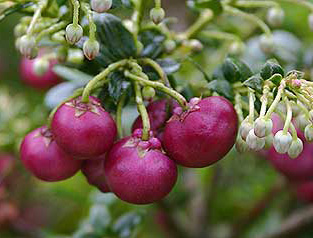
I added Gaultheria mucronata (photo, top right) to my garden without realizing the berries were good for winter interest. Its evergreen foliage, although somewhat prickly, makes a choice three-foot tall hedge that looks good year round. The bright berries with their matte finish hang on the shrub until December, with a bonus of bronze colored winter foliage. G. mucronata 'Alba' has white berries, and G. mucronata'Heronswood Variegated' grows to three feet tall with white streaks on its leaves. Adding a male plant for pollination will result in better fruit production -- a good choice would be a male, G. mucronata 'Thymifolia'. You can use it as an eight inch high groundcover at the base of the taller gaultherias.
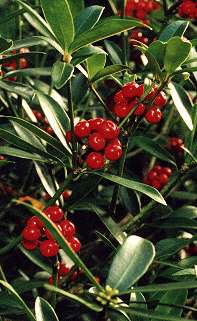
A more commonly grown evergreen shrub, Skimmia japonica (photo on left), brings its shiny red or white berries out in winter. Its beautiful glossy foliage blends well with other shade plants, making this a perfect year round plant. Male and female plants are needed for berries to light up the shade garden all winter. The male's flowers are very fragrant, blooming in late spring. The rest of the year, the glossy evergreen foliage makes a good backdrop for flowering perennials. Skimmia berries can cause stomach upset so instruct your children not to eat them.
Billardiera longiflora is a vine that produces violet-purple, oblong berries that hang on the vine well into January. I planted my vine at the base of Nandina domestica, where it settled in comfortably and now climbs the nandinas with ease. Billardiera reaches six feet tall and blooms in summer with long trumpet-shaped, yellow flowers. Mine has not flowered, so I look forward to its fruit hanging on the nandinas like ornaments in winter.
Another evergreen vine, Lonicera henryi (honeysuckle), has blue berries. The berries hold on to this vigorous vine well into December. I value it year round because it blooms in summer, has evergreen leaves and long lasting berries in winter. The tubular, purplish-red flowers attract hummingbirds, while other birds make a feast of the berries. Since it climbs up to thirty feet, it can quickly make a vertical statement in the garden. I am adding L. alesuosmoides to my garden for its winterberries of dark blue. It will also be a hummingbird magnet with its tubular flowers.
In his book, My Garden in Autumn and Winter, E. A. Bowles writes about Coprosma, an evergreen shrub from New Zealand. He hoped to see the winterberries from C. acerosa and C. propinqua in his garden. I do not know if he ever saw a berry from them in his garden, but I like to think he did. From what I can find, C. acerosa (now accepted as C. brunnea) is the hardiest of the species and can be grown in our maritime climate. I am tempted to try this New Zealand native because of the translucent blue berries that follow autumn flowering. Even if the berries do not last into winter, the evergreen, glossy foliage that trails along the ground would still be of value in my winter rock garden. Another New Zealand species hardy in our climate is Coprosma robusta. This one might be great for the bright shade garden. Berries follow the cream-colored flowers in autumn, on stems with glossy evergreen leaves. Both are on my list for a future planting.
by Debbie Teashon

Gardening for the Homebrewer: Grow and Process Plants for Making Beer, Wine, Gruit, Cider, Perry, and More

By co-authors Debbie Teashon (Rainy Side Gardeners) and Wendy Tweton
Copyright Notice | Home | Search | Archives