

Primula x polyanthus 'Green Lace'
PRIMROSE
Family: Primulaceae
Pronounced: PRIM-yew-la
Quick Jumps
Growing Guide
Rainy Side Notes
GROWING GUIDE
Origin:
Garden
Plant Group:
Perennial.
Hardiness:
Sunset zones: 1-24.
USDA zones: 5-7.
Heat zones: 7-5.
Mature size:
Height: 4 inches (10 cm) with flowers 9 inches (23 cm).
Width: 9 inches (23 cm).
Flowering period:
Spring into summer.
Flowering attributes:
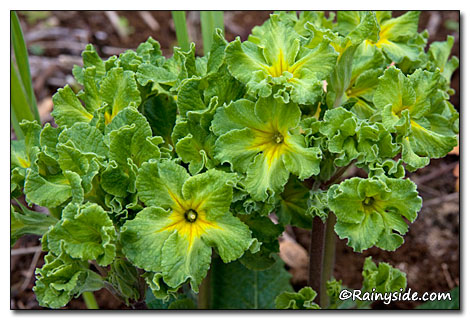
Large, frilly, green flowers with yellow centers and red veining.
Leaf attributes:
Evergreen, oval, dark green leaves.
Growth habit:
Rosette forming.
Light:
Partial, dappled shade and full sun (full sun in cool summer climates only).
Soil:
Moist, humus rich, well-drained, neutral to slightly acidic soil.
Feeding:
In spring, side dress with compost or top dress with leaf mold and a complete organic fertilizer.
Propagation methods:
Divide after flowering.
Divide in autumn in mild winter areas.
Rainy Side Notes
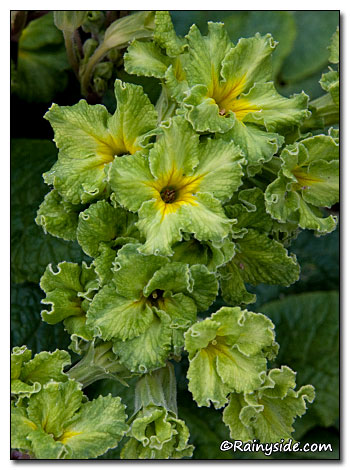
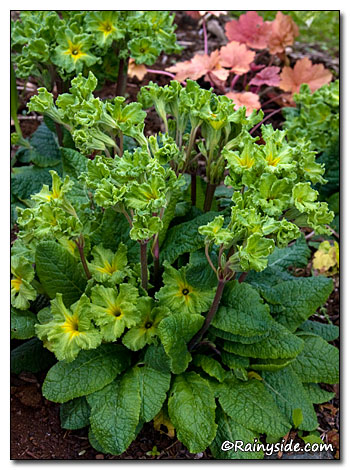
The rosette-forming Primula 'Green Lace' was bred by Sandra Tuffin, who owned Uncommon Ground Nursery in Wardsville Ontario, and introduced the plant into the trade in 2002. I first spied a drift of this plant in 2007 at the Terra Nova Nursery's display garden in Canby, Oregon. The lime-green flowers with yellow throats and red veining covered the plants, obliterating the foliage beneath them. I knew I had to have some. I inquired about the green flowering primrose and was informed they no longer propagated them.
The hunt was on. I found P. 'Francesca', a similar cultivar and attractive in its own right, but I set out to find the other. It took about six months to find 'Green Lace' in the trade. Fortunately, Digging Dog, a mail-order nursery out of California, had them in stock. I now have several growing in light shade under a plum tree. They are easier to find in some nurseries these days, a tribute to their beauty, profusion of bloom, and staying power in the garden.
The polyanthus group, which this cultivar is a member of, is believed to be a cross that includes P. veris, P. elatior, and P. vulgaris. Whatever its parentage, this little perennial, with its frilly, lime-green flower, is outstanding in the shade garden. However, in our cool, summer climate, we can grow it in the full sun garden too.
Divide the plants every two to three years to keep them from declining; otherwise, they will die out after a few years.
Debbie Teashon
Photographed in author's garden.
A Pacific Northwest Plant of the Week (2013)

Gardening for the Homebrewer: Grow and Process Plants for Making Beer, Wine, Gruit, Cider, Perry, and More

By co-authors Debbie Teashon (Rainy Side Gardeners) and Wendy Tweton
Copyright Notice | Home | Search | Perennials