
Fatshedera lizei 'Aurea Maculata'
ARALIA IVY, BOTANICAL WONDER, TREE IVY
Family: Araliaceae
Quick Jumps
Growing Guide
Rainy Side Notes
GROWING GUIDE
Origin:
France.
Plant Group:
Shrubs.
Hardiness:
Sunset zones: 4-10, 12-24.
USDA: zones 8-11.
Mature size:
Height: 4-6 feet (1.2-2 m).
Width: 10 feet (3 m).
Flowering period:
Fall.
Flowering attributes:
Umbel-like panicles of sterile white flowers.
Leaf attributes:
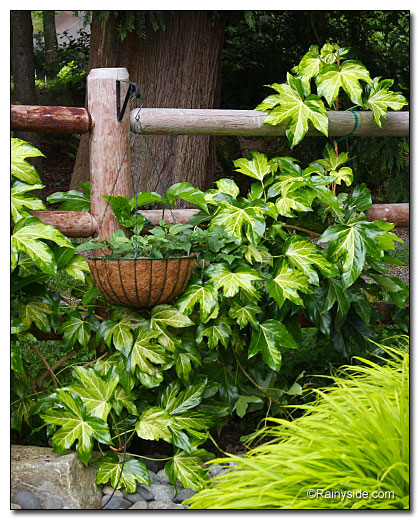
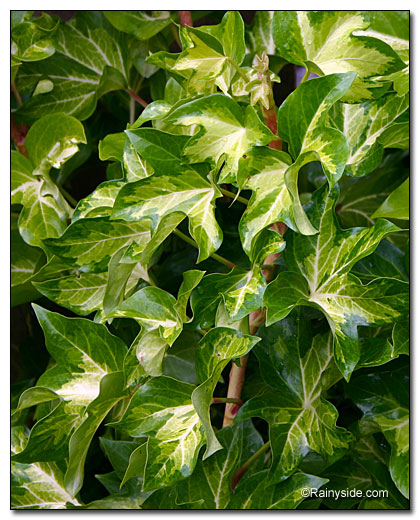
Large deeply lobed (5-7 lobes) glossy leaves up 10 inches wide on red stems. Leaves are green with lighter green to white splotches in the center.
Growth habit:
Clump forming.
Light:
Full sun to light to partial shade.
Soil:
Moist, but well-drained (especially in winter), fertile soil.
Feeding:
Side dress with compost or manure in the fall. Fertilize monthly, spring through early summer with a complete organic fertilizer. If leaves continually turn yellow, provide iron.
Propagation Methods:
Greenwood cuttings in early summer with bottom heat. | Heel cuttings anytime of the year. | Semi-ripe stem tips in summer.
Pruning Methods:
Prune in late winter to early spring or in fall. Remove dead branches or if grown as a ground cover prune out any stems that try to grow upward. Pinch to encourage bushiness if growing as a shrub. Renew plant by cutting all the way to the ground in spring.
Pests and Diseases:
May be susceptible to fungal and bacterial leaf spots. Spider mites, and white fly may be problematic for the plant.
Rainy Side Notes
A rare moment in nature produced this inter-generic cross—Fatshedera lizei. The plant was first discovered in France in 1910, growing in a nursery.
If you like the look of ivy but you know it causes problems in the Pacific Northwest, this ivy-and-Fatsia cross is a good choice. Fatshedera looks like a larger, more robust ivy with expansive foliage but does not harm trees or anything nearby. You have several ways to enjoy its beauty. You can grow it as a vine by tying it to a sturdy support. Its large, tropical-looking leaves can reach up to 10 inches and look great as a vine. You can also grow it as a shrub by pinching it to encourage bushier growth, or as a ground cover by trimming any upward shoots. It even works as a houseplant, though I prefer seeing it outside in our mild climate.
Fatshedera is sterile, so there are no worries about it escaping into the wild, unlike one of its wayward parents. The shrub doesn’t have clinging roots, so it needs to be tied if you want it to climb. I grew mine along a fence to hide the tube for a water feature. And yes, its foliage really is beautiful.
Fatshedera is semi-deciduous. New growth is damaged if temperatures drop below 20°°F, and older growth is affected at 15°F. If it gets colder than 10°F, the plant will die back to the ground, but it readily resprouts. Hard frosts in the upper twenties won't harm the leaves.
Photographed in author's garden.
A Pacific Northwest Plant of the Week (2012)

Gardening for the Homebrewer: Grow and Process Plants for Making Beer, Wine, Gruit, Cider, Perry, and More

By co-authors Debbie Teashon (Rainy Side Gardeners) and Wendy Tweton.
Copyright Notice | Home | Search | Shrubs & Trees