

Rosa 'Mme. Hardy'
DAMASK ROSE
Family: Rosaceae
Pronounced: RO-sa
Quick Jumps
Growing Guide
Rainy Side Notes
GROWING GUIDE
Origin:
Garden.
Plant Group:
Shrubs.
Hardiness:
Sunset zones: All.
USDA zones: 4-9.
Heat zones: 9-1.
Mature size:
Height 5-6 feet (1.5-2 m).
Width: 4 feet (1 m).
Flowering period:
June.
Flowering attributes:
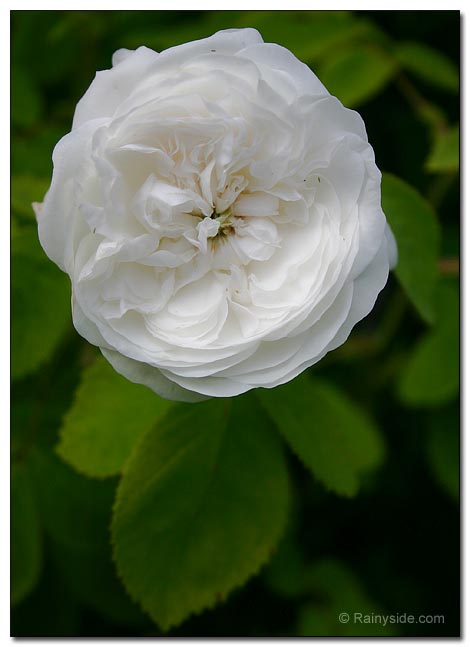
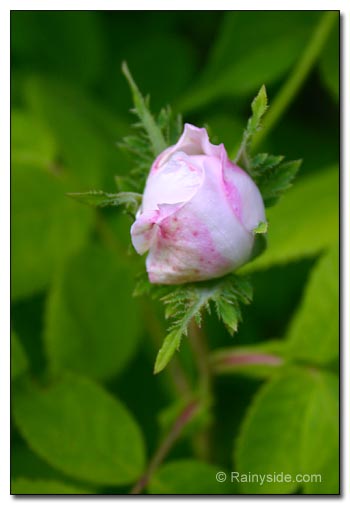
Double, fragrant, white flower with 60+ petals and a green button eye. Buds are blushed, open blushed, then fades to white.
Leaf attributes:
Leathery, light green leaves.
Growth habit:
Upright shrub.
Light:
Full sun.
Soil:
Fertile, humus rich, well-drained soil.
Feeding:
Fertilize once a month with a complete organic fertilizer during the growing season.
Propagation Methods:
Softwood cuttings in spring.
Hardwood cuttings in autumn.
Pruning Methods:
Prune immediately after flowering. Main stems should be cut back by one-quarter and side shoots by two-thirds where necessary.
Pests and Diseases:
Aphids may be a problem.
Rainy Side Notes
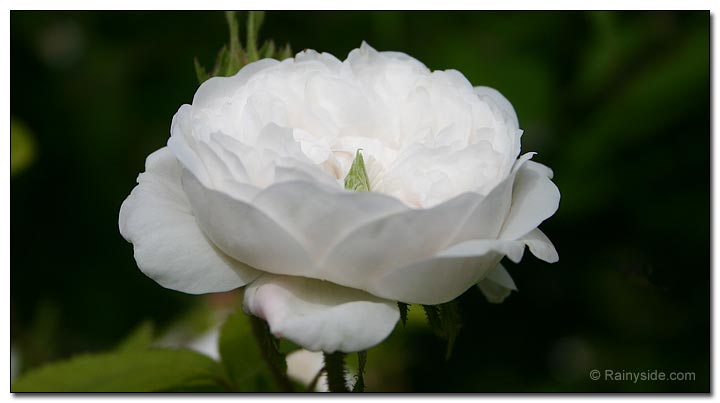

Growing six feet tall into a fountain shape, and wonderfully fragrant, this old rose is a favorite of mine. In June, I use the fragrant petals to make rose water. Pink buds open up a blush pink, and then fade to white. It is very disease-resistant, and for organic gardeners, it is a great rose to grow.
Rosa 'Mme. Hardy', a June-flowering, Damask rose, is a French variety that dates back to 1832. Monsieur Hardy raised this cultivar at the famous Luxembourg Gardens in France. It was named after Monsieur Hardy's wife.
One of many cultivars of the Damask roses (Damask refers to Damascus, Syria, from where, it is said, the Crusaders brought these roses back to Europe). Robert de Brie, a chevalier, may have brought the first Damask rose to France between 1254 and 1276. Another story says the Romans brought the rose to England. Yet another account is that the king's physician gave Henry VIII of England a Damask rose as a present around 1540. There is speculation that the Damask rose may be a cross between R. gallica and R. Phoenicia.

Photographed in author's garden.
Gardening for the Homebrewer: Grow and Process Plants for Making Beer, Wine, Gruit, Cider, Perry, and More

By co-authors Debbie Teashon (Rainy Side Gardeners) and Wendy Tweton.
Copyright Notice | Home | Search | Shrubs & Trees